BASF, DHL and Hager executives cite regulatory burdens, stagnant growth; point to Korea's manufacturing speed as a model
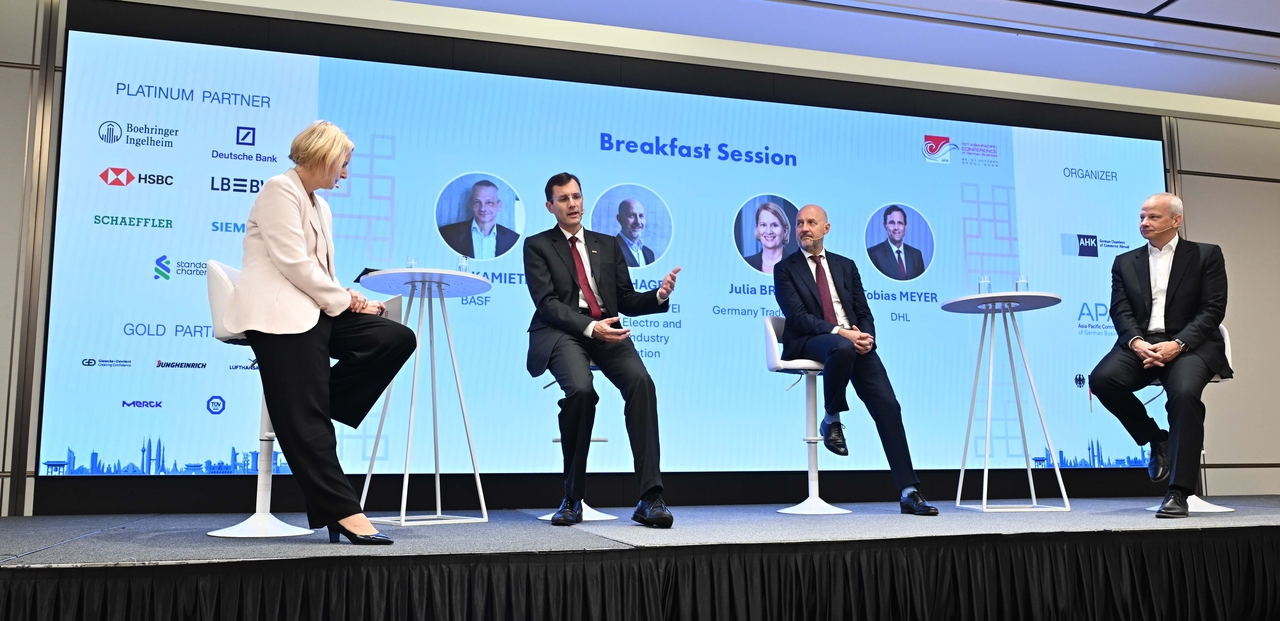
European industrial leaders warned Saturday that excessive regulation and years of stagnant growth are eroding the region's competitiveness, urging faster decision-making and pointing to South Korea's manufacturing prowess as a model.
Speaking at a breakfast session of the 2026 Asia-Pacific Conference of German Business in Seoul, executives from BASF, DHL Group and Hager Group discussed how businesses can navigate rising protectionism and geopolitical uncertainty.
Despite mounting trade barriers, global commerce remains resilient, fueled by demand for advanced technologies, DHL Group CEO Tobias Meyer said.
“Tech beats tariffs,” Meyer said, noting that AI and semiconductor demand accounted for more than 80 percent of global trade growth in the first half of this year.
But Europe's industrial outlook remains bleak, BASF CEO Markus Kamieth said.
“Our biggest problem in Europe is not energy costs, it is the complete lack of growth. German industrial production has seen zero growth for seven years,” he said.
Kamieth criticized Europe's regulatory burden, saying he could name 20 regulations that had raised business costs but none that had lowered them. Without restoring cost competitiveness, he warned, Europe risks relying on protectionism and becoming an “isolated island.”
Daniel Hager, CEO of Hager Group and president of Germany's Electro and Digital Industry Association (ZVEI), echoed those concerns, citing Europe's declining share of global trade.
He criticized contradictory policies that subsidize semiconductor manufacturing while imposing environmental and labor regulations that undermine its commercial viability.
Against this backdrop, the executives highlighted Korea as a model of competitive, export-oriented manufacturing.
Asked about efficient production bases outside China, Kamieth pointed to Korea, saying BASF exports more than half of its Korean production to global markets.
Meyer also praised Korea's strength in semiconductors and its ability to retain critical upstream supply chains.
Kamieth urged European companies to embrace Korea's “ppalli-ppalli,” or hurry-hurry, culture, stressing that faster decision-making and execution are essential to competing globally.
The executives' message was clear: Europe's biggest challenge lies not only in external trade pressures but also in overcoming its own structural barriers to growth.
hyejin2@heraldcorp.com